
23321 El Toro Road, Suite B, Lake Forest, CA 92630

Single Tooth Implants Lake Forest, CA

A single missing tooth is a bigger problem than most patients realize

A single tooth implant begins with a CBCT 3D cone-beam scan, not a 2D X-ray. Simplant or Nobelvision digital planning positions the implant virtually and designs a surgical guide. The final crown is designed using iTero digital impressions.
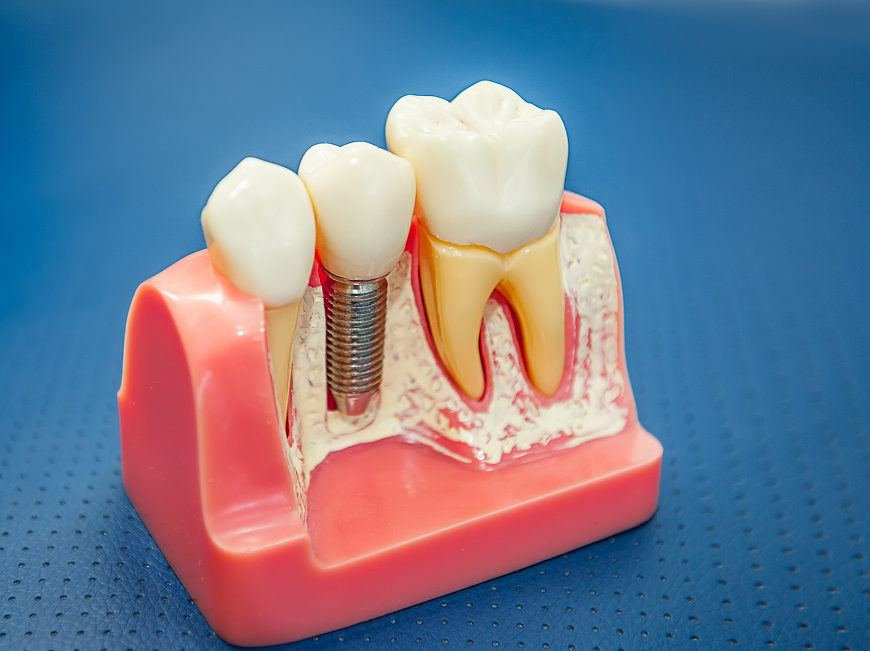

Three components of a single tooth implant — fixture, abutment, crown

The three components of a single implant

  • Implant fixture: titanium post (typically Straumann BLX or BLT), integrates over 6–12 weeks
  • Abutment: precision connector designed digitally
  • Crown: zirconia or PFM restoration from iTero digital impressions
Bone loss and tooth drift from an unreplaced missing tooth

What happens to your jaw when a tooth goes unreplaced

  • Up to 25% of bone volume at the extraction site can be lost within the first year
  • Adjacent teeth drift/tilt; opposing tooth may super-erupt
  • Preserves alveolar bone, prevents tipping, restores occlusal function, maintains facial profile
Request an Appointment

The single implant process

1

CBCT Consultation & Digital Planning

3D scan reviewed directly; Simplant/Nobelvision planning and surgical guide design.

2

Implant Placement

Minimally invasive placement, usually under an hour under local anesthesia; IV sedation available.

3

Osseointegration (6–12 weeks)

Implant integrates with bone; periodic check-ins.

4

iTero Scanning & Final Crown

Digital impression; zirconia or PFM crown fabricated and seated.
Long-term success of single tooth implants — 95%+ at 10 years

Are you a candidate?

  • Bone volume/density at implant site
  • Proximity to nerve, sinus, adjacent roots
  • Periodontal health
  • Occlusal forces/bite geometry
  • Medical history factors (controlled diabetes, bisphosphonate use, etc.)
Request an Appointment

Cost depends on the implant system used, whether a bone graft is needed first, and the final crown material chosen. Dental insurance often contributes toward diagnostic imaging and a portion of the crown, though coverage for the implant fixture itself varies by plan — we verify your benefits and provide an itemized estimate at your consultation.

We treat single tooth implant patients from throughout Lake Forest as well as Mission Viejo, Irvine, and Foothill Ranch, all planned with the same CBCT and digital-impression protocol described above.

Long-term outcomes

Success rates consistently above 95% at 10 years in peer-reviewed literature with proper surgical protocol and prosthetic design.

Single Tooth Implants: Common Questions

Yes. Beyond the gap itself, an unreplaced tooth allows bone loss at the site, drifting or tilting of neighboring teeth, and super-eruption of the opposing tooth — changes that get harder to correct the longer they're left alone.
Most patients with adequate bone volume and healthy gums are candidates. A CBCT scan confirms bone quality and proximity to nerves, sinuses, or adjacent roots; medical history factors like controlled diabetes are also considered, not automatically disqualifying.
Placement itself is usually under an hour. From there, osseointegration takes 6–12 weeks before the final crown is designed and seated, so most cases run a few months start to finish.
Not typically — a temporary tooth option can usually be arranged for the healing period so you're not showing a gap, and we'll discuss what fits your case at consultation.
Only if the CBCT scan shows insufficient bone volume at the site. Many single-tooth cases don't need grafting; when it is needed, we complete that healing phase first, then proceed to implant placement.
The implant is the titanium post that replaces the tooth root, placed in the jawbone. The crown is the visible replacement tooth on top, attached to the implant through a connecting abutment — together they replace both the root and the crown of a natural tooth.
📍 Click to view map