
If you're missing most or all of your teeth, implants can anchor your denture two ways: a removable snap-in overdenture, or a fixed hybrid you don't take out. Which one is right depends on your bone, your bite, and your goals.
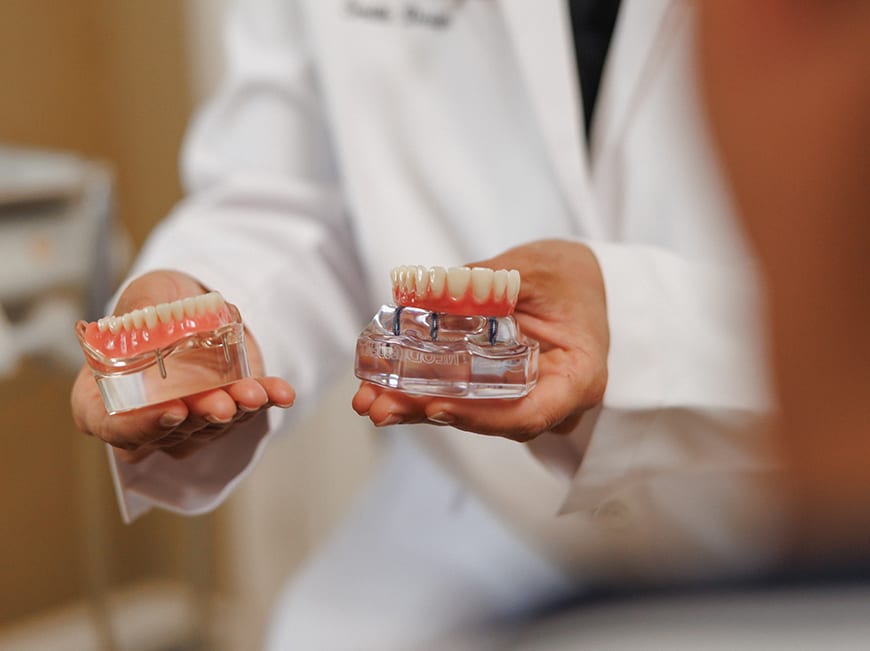
A conventional denture rests on the gum ridge and stays in place through suction and adhesive alone. As the underlying bone continues to resorb — which happens continuously once teeth are gone — that fit gets worse, not better. Slipping while eating or speaking, sore spots, and the need for repeated relines are the predictable result, not a sign you're doing something wrong.
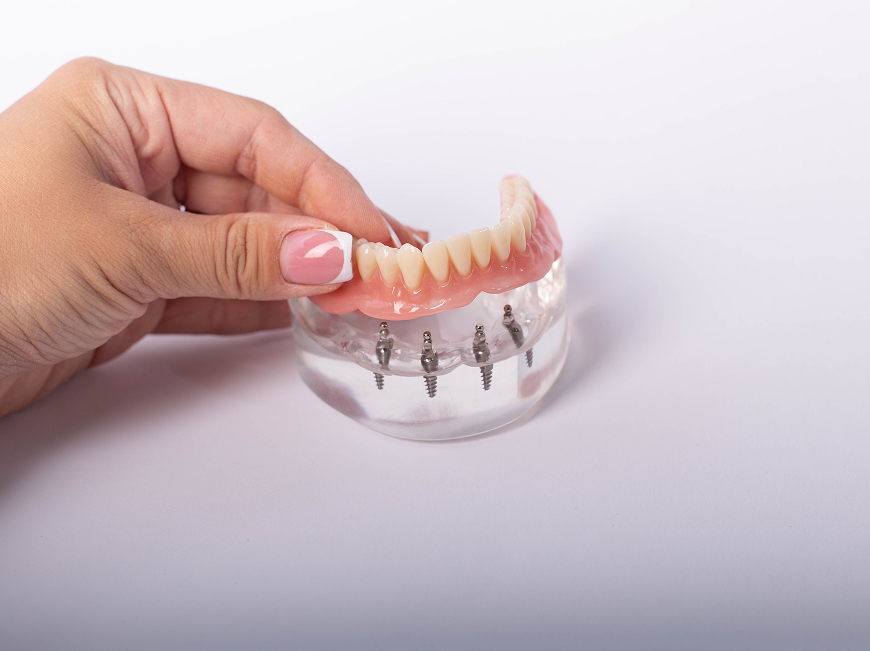
Implant-supported dentures solve the retention problem directly: a small number of implants placed in the jawbone give the denture something fixed to attach to, instead of relying on the changing shape of your gums.
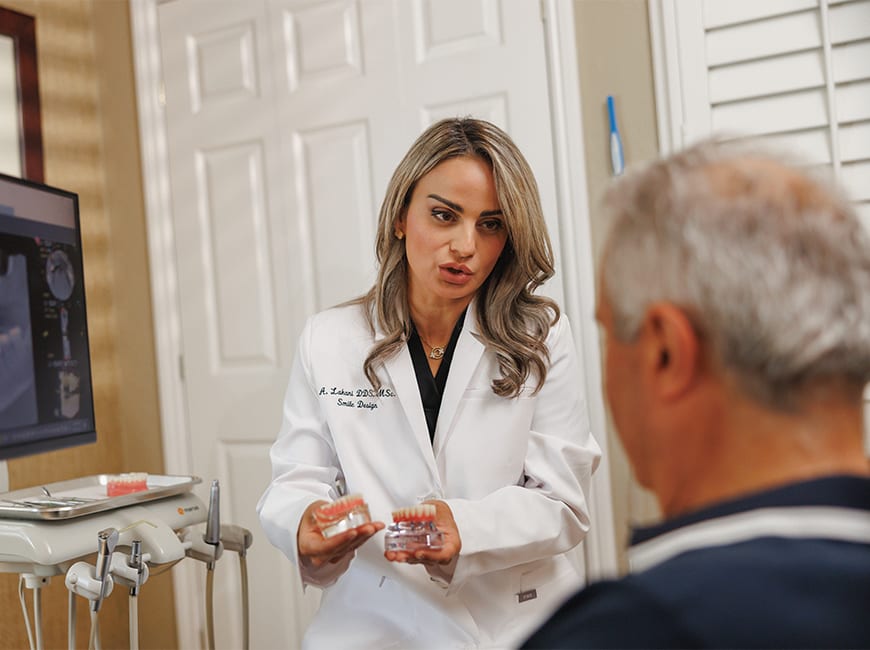
The number of implants and the attachment method determine whether the result is removable or fixed. Both start with the same CBCT-planned surgical approach; they differ in daily use.
Request an Appointment| Removable (Snap-In Overdenture) | Fixed (Hybrid / Permanent Bridge) | |
|---|---|---|
| Implants per arch | Typically 2–4 | Typically 4–6 |
| How it attaches | Locator or bar attachments — snaps in and out | Screwed to the implants — removed only by our office |
| Patient removes for cleaning | Yes, nightly | No |
| Feel | More stable than a traditional denture; some palate coverage may remain | Closest to natural teeth; typically no palate coverage |
| Cost | Lower — fewer implants | Higher — more implants, more complex prosthesis |
| Best for | Patients who want a step up from traditional dentures without maximal cost | Patients who want the most fixed, natural-feeling result |
Which option — and how many implants — depends on the bone volume and density in your jaw, evaluated with a CBCT 3D scan at consultation. Patients who have worn dentures for many years often have significant bone loss from the lack of tooth-root stimulation; this doesn't rule out treatment, but it does inform whether grafting is needed before implant placement, and how many implants the site can support.
Where bone volume is limited, bone grafting, ridge augmentation, or sinus lift (for upper-arch cases) can rebuild the foundation needed for a stable result.
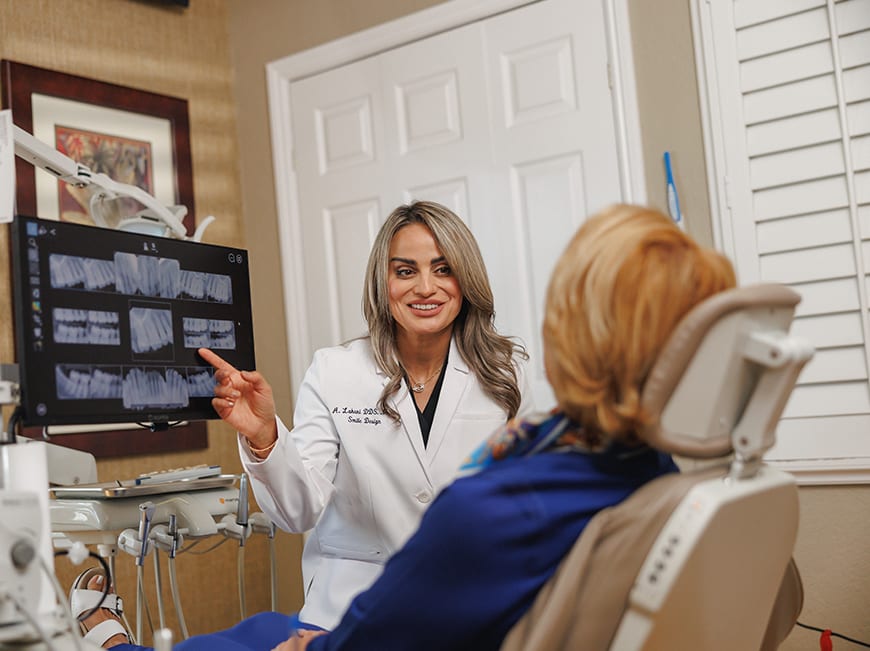
A CBCT evaluation is the only reliable way to determine which option — and how many implants — fits your case.
3D imaging determines bone volume, the number of implants needed, and whether removable or fixed is the better fit for your anatomy and goals.
Implants are placed under local anesthesia or IV sedation. A temporary denture may be worn during healing.
Implants fuse with the jawbone over several months, creating the stable foundation the final prosthesis attaches to.
For removable cases, locator attachments are fitted to the denture. For fixed cases, the hybrid bridge is fabricated using digital impressions.
The finished prosthesis is seated, and bite and fit are refined so pressure is distributed evenly across all implants.
We treat implant-supported denture patients from throughout Lake Forest as well as Mission Viejo, Irvine, and Foothill Ranch. Every case — removable or fixed — starts with the same CBCT bone assessment described above.